
Introduction
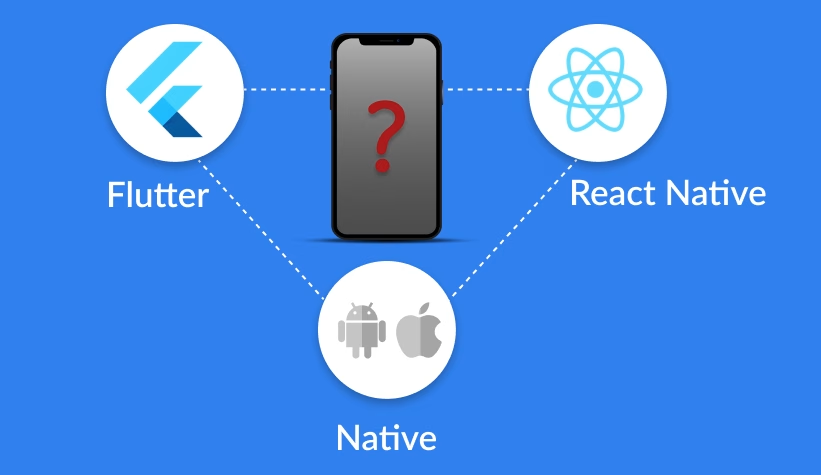
In the rapidly evolving world of mobile development, cross-platform frameworks have become a go-to solution for businesses looking to save time, resources, and development costs. As of 2025, Flutter and React Native stand as the two most dominant frameworks for building mobile apps. Both enable developers to create high-performance applications for iOS and Android using a single codebase—but which one is better for your next project in 2025?
This article breaks down the key differences, pros, and cons of Flutter and React Native to help you decide which framework aligns best with your goals.
Flutter in 2025
Flutter, backed by Google, has evolved significantly since its inception. By 2025, Flutter offers robust capabilities for not only mobile, but also web, desktop, and embedded app development.
Flutter uses the Dart programming language, which is optimized for building fast, reactive UIs. With Dart 3.x, the framework now includes features like improved null safety, faster compile times, and enhanced performance.
Flutter’s unique approach of using its own rendering engine (Skia) allows developers to build beautiful UIs that look consistent across all platforms. It also comes with a rich set of pre-designed widgets that follow both Material and Cupertino design principles.
Advantages of Flutter in 2025
- Native-like performance thanks to direct compilation to ARM code.
- Consistent UI across platforms with custom rendering.
- Strong tooling support including Flutter DevTools and VS Code integration.
- Rapid development with hot reload and stateful hot restart.
- Full support for Material 3 and custom animations.
- Expanding ecosystem with support for web, desktop, and embedded systems.
Limitations
- Dart is still not as widely adopted as JavaScript.
- Larger app size compared to React Native.
- Some third-party plugins may still be under development for niche use-cases.
React Native in 2025
React Native, developed by Meta (formerly Facebook), continues to be a top choice for mobile developers, especially those familiar with JavaScript and React. The framework has matured significantly and now features TurboModules, Fabric rendering engine, and a tightly integrated Hermes JavaScript engine for faster and smoother performance.
In 2025, React Native benefits from the vast JavaScript ecosystem, making it easy to find libraries, packages, and developers. With improved TypeScript support, React Native is now more type-safe and developer-friendly.
Advantages of React Native in 2025
- Leverages JavaScript/TypeScript, which are widely known languages.
- Improved performance with Hermes and the new architecture.
- Large community and rich plugin ecosystem.
- Strong integration with native modules through TurboModules.
- Easier onboarding for web developers transitioning to mobile.
- Mature tooling like React DevTools, Metro bundler, and CLI tools.
Limitations
- Performance still depends on the bridge for certain native functionalities.
- UI consistency can vary across platforms due to reliance on native components.
- Debugging can sometimes be more complex compared to Flutter.
Flutter vs. React Native: Key Differences in 2025
When deciding between Flutter and React Native in 2025, consider the following key differences:
- Language: Flutter uses Dart, which may require learning a new syntax. React Native uses JavaScript, which is already familiar to many developers.
- Performance: Flutter generally offers better performance due to its native compilation and custom rendering engine. React Native has improved performance with Hermes and Fabric but may still face issues with complex animations or bridging.
- UI Development: Flutter offers a wide range of built-in, customizable widgets for UI, whereas React Native relies more on third-party or native components, leading to potential inconsistencies.
- Community & Ecosystem: React Native has a more mature and larger community, especially for mobile-only apps. Flutter’s community is growing quickly, especially as it expands to web and desktop.
- Platform Support: Flutter supports a broader range of platforms including embedded systems, while React Native remains primarily mobile-focused.
Which One Should You Choose in 2025?
The decision between Flutter and React Native in 2025 ultimately depends on your project goals, team expertise, and performance requirements.
Choose Flutter if:
- You want consistent UI across all platforms.
- Performance is critical (e.g., apps with heavy animations or custom UIs).
- You aim to target web, desktop, and embedded systems alongside mobile.
- Your team is open to using Dart or already familiar with it.
Choose React Native if:
- You want to leverage existing JavaScript/TypeScript skills.
- Your app relies heavily on native modules or third-party packages.
- You need fast development for MVPs or internal apps.
- You’re focused solely on mobile app development.